· Prakash Natarajan · Reliability · 16 min read
LangChain vs LlamaIndex: Which Traces Cleaner
LangChain and LlamaIndex split on orchestration versus retrieval, but the choice that actually costs you later is which one is easier to trace, test, and isolate per tenant. Here's the real comparison, plus where CrewAI fits.
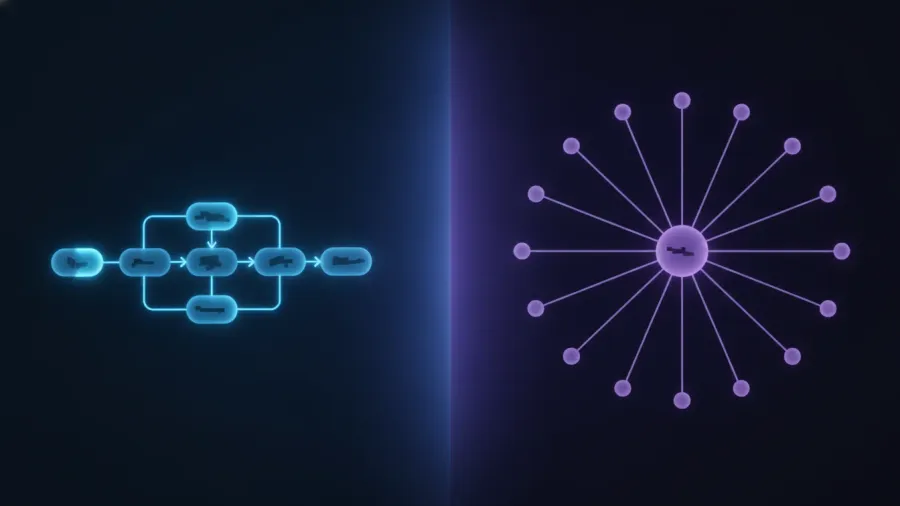
LangChain and LlamaIndex split on what they were built for: LlamaIndex started as a retrieval framework for getting your own data into an LLM’s context cleanly, and LangChain started as an orchestration framework for chaining calls, tools, and state together into a working agent. Both have grown well past that original split, LlamaIndex now ships its own agent and workflow primitives, and LangChain now ships strong retrieval and indexing support through LangGraph, so picking between them on features alone gets you a coin flip. The choice that actually costs you six months from now is which one is easier to trace, easier to test without buying a second product, and easier to keep one tenant’s data out of another’s once you have paying customers. This piece covers the standard comparison, then the three questions the existing comparisons skip, including where CrewAI fits if you’re already choosing between the other two.
What’s the real difference between LangChain and LlamaIndex?
LangChain, through LangGraph, is built around explicit state and control flow: you define nodes, edges, and a graph that can branch, loop, and pause for a human to step in, which makes it the stronger choice when your agent’s job is a multi-step process with real decision points. LlamaIndex is built around getting the right data in front of the model efficiently: its ingestion pipelines, over three hundred data connectors, and query engines are built specifically for retrieval-augmented generation, and its indexing strategies go deeper than LangChain’s equivalents.

In practice this means a support copilot that mostly answers questions against a knowledge base leans on LlamaIndex’s strengths, while a sales assistant that has to check a CRM, decide whether to escalate, and loop back after a tool call leans on LangGraph’s explicit state model. Neither framework locks you out of the other’s core job. LangGraph can do retrieval, LlamaIndex’s workflow module can do multi-step orchestration, and most production agents past a certain size end up using pieces of both, LlamaIndex for ingestion and retrieval, LangGraph for the control flow around it. Treat the retrieval-versus-orchestration split as a starting point for where each framework is strongest, not a hard boundary on what either one can technically do.
Both frameworks also sit on the same core license, MIT, so the choice is never about paying to get started. What you pay for later is the commercial layer each vendor sells on top: LangSmith for LangChain, LlamaCloud for LlamaIndex’s hosted parsing and indexing. Neither commercial product is required to ship an agent, but both are built to be the natural next step once you outgrow the open-source library on its own, which matters more for the tracing and testing questions below than it does for picking the base framework itself.
Where does CrewAI fit if you’re already choosing between these two?
CrewAI fits in as a third option built specifically for role-based multi-agent teams, worth a look if your agent is really several specialized agents cooperating rather than one agent with a set of tools. Where LangGraph gives you a general-purpose state graph and LlamaIndex gives you a general-purpose retrieval and workflow engine, CrewAI is opinionated about a narrower shape: you define agents with roles, goals, and backstories, assign them tasks, and CrewAI handles the coordination between them, either in a fixed sequence or with one agent delegating to others.

That opinionated shape is CrewAI’s biggest advantage and its biggest limit at the same time. A research-and-writing pipeline, one agent gathering facts, one drafting, one reviewing, maps naturally onto CrewAI’s role model and takes noticeably less boilerplate to stand up than the same pipeline in LangGraph. A single agent juggling a dozen tools with complex conditional branching fights the role-based model instead of fitting it, and that’s where LangGraph’s flexibility earns its extra setup cost back. CrewAI also lets you run a crew as a fixed sequence, where each agent’s task hands off to the next in order, or with a manager process that decides who handles each task as the crew runs, which is closer in spirit to LangGraph’s branching than the framework’s beginner examples usually let on.
If you’re comparing all three because you’re building a B2B2C product with LangChain, LlamaIndex, or CrewAI integrations, as AiAgRe’s own SDK does, the honest answer is that the framework choice is rarely a single winner across your whole product. Most teams end up picking per agent, not per company, a retrieval-heavy support agent on LlamaIndex, a role-based research workflow on CrewAI, and a branching sales assistant on LangGraph, all reporting into the same reliability and analytics layer underneath.
Which framework is actually easier to trace before you can show a customer a number?
LangChain officially recommends its own commercial platform, LangSmith, as the primary way to trace, debug, and evaluate anything built with LangGraph, and setup is genuinely quick: one environment variable and traces start flowing. LlamaIndex and CrewAI both take the opposite approach, neither ships a default tracer at all, and both point you toward an open field of third-party options instead.

LlamaIndex’s documentation lists more than a dozen supported integrations, including native OpenTelemetry instrumentation alongside Arize Phoenix, Langfuse, MLflow, Weights and Biases Weave, and Comet Opik, so nothing about your trace data is tied to one vendor’s SaaS product. CrewAI supports a similar spread, ten or more named platforms including Langfuse, Arize Phoenix, Portkey, and OpenLIT, with OpenLIT specifically built on OpenTelemetry. LangChain’s own documentation describes LangSmith as letting you “inspect traces, tool calls, state transitions, and latency in one place,” and points to an additional monitoring layer on top of that, LangSmith Engine, built to detect issues and propose fixes automatically once traces are flowing.
The trade-off is exactly what you’d expect: LangChain’s path is faster to turn on because it was designed as one integrated product, while LlamaIndex and CrewAI’s path takes more setup work but leaves you free to route traces wherever your own reliability stack actually lives, including a tool built to show that trace data to your own customers rather than just your own team. This is the same distinction covered in more depth in AI agent observability: a trace that only your team can see and a trace you can turn into a number your customer trusts are two different engineering problems, and the framework you pick decides how much of that second problem you inherit for free.
Which framework is easier to test, not just easier to monitor?
LlamaIndex ships genuinely built-in evaluation tooling in the open-source library itself, correctness, faithfulness, context relevancy, answer relevancy, and guideline adherence evaluators, plus retrieval metrics like mean-reciprocal rank and hit-rate, and most of them run without needing ground-truth labels at all. It can even generate synthetic evaluation questions straight from your own indexed data, so you have a starting test set before you’ve written a single case by hand. CrewAI ships a crewai test command that runs your crew for a set number of iterations, two by default, and scores each task from one to ten, a real built-in eval loop, though as of this writing it’s locked to OpenAI’s gpt-4o-mini as the default scoring model, with the model configurable but the provider fixed to OpenAI.

LangChain’s evaluation story, by contrast, mostly lives inside LangSmith rather than the open-source library: the documentation itself points you to LangSmith to “find failure modes, evaluate quality, and improve agent behavior,” which means a serious LangGraph testing setup usually means adopting LangSmith rather than reaching for a native module in the base package. None of these three replace the actual test-set work covered in AI agent testing, hand-written adversarial cases, a golden dataset that grows with real production failures, a decision on code-based checks versus a model as the judge. What the framework gives you is a head start on the mechanics, and LlamaIndex currently gives you the most of that mechanics for free, in the open-source package, before you touch a third-party platform at all.
What breaks first when you add multi-tenant on top of either framework?
Neither framework was built with a B2B2C multi-tenant product in mind, so the same failure mode shows up in both once you add a second layer of customers underneath your own: a shared retrieval index or a shared conversation memory store returns another tenant’s data because nothing in the framework’s default configuration scopes a query to one tenant automatically.

LlamaIndex’s vector store integrations generally support metadata filtering, which means you can tag every document with a tenant identifier and filter on it, but that filter has to be applied by you, explicitly, on every single query path, and a new retrieval flow added six months from now with a missing filter is an easy way to leak. LangGraph’s persistence layer, checkpoints and threads that let a conversation resume where it left off, has the same shape of gap: a thread ID is not a tenant boundary by default, and nothing stops a bug from resuming the wrong customer’s thread state if the two identifiers get conflated anywhere in your routing code. CrewAI’s crew and task state carries the same risk if a shared long-term memory store is reused across crews running for different customers.
A vertical AI SaaS company building a leasing assistant for property managers is a realistic version of this. Each property manager is a tenant, and each of their individual properties or tenants inside the software creates a second layer underneath that, exactly the kind of double multi-tenant shape none of these three frameworks were designed around. A shared LlamaIndex retrieval index across every property manager’s lease documents, filtered only by a top-level account ID, can still surface one property’s lease terms inside another property’s conversation if the filter never got extended down to that second layer. This is the exact problem covered from the data-layer side in tenant isolation for AI agents: the fix in every one of these frameworks is the same, tag tenant identity at the point of ingestion, filter at the query layer itself rather than after the results come back, and test the boundary by deliberately trying to cross it, because none of these three frameworks will catch that mistake for you.
So which one should you actually pick?
Pick LlamaIndex first if your agent’s core job is answering questions against your own data and you want built-in evaluation and open tracing without adopting a second product. Pick LangGraph first if your agent’s core job is a multi-step process with real branching and human checkpoints, and you’re fine adopting LangSmith as part of that decision, since its tracing setup is the fastest of the three to stand up. Pick CrewAI first if your agent is genuinely a team of specialized roles rather than one agent with a toolbox, and you can live with its current OpenAI-only testing command until that changes.

| LangChain (LangGraph) | LlamaIndex | CrewAI | |
|---|---|---|---|
| Core strength | Multi-step orchestration, branching, human-in-the-loop | Retrieval, ingestion, 300+ data connectors | Role-based multi-agent teams |
| Default tracer | LangSmith (official, fastest setup) | None; OpenTelemetry-native + 12+ integrations | None; 10+ third-party integrations |
| Built-in eval | Lives in LangSmith, not the open-source library | Native evaluators, no ground truth needed | crewai test CLI, OpenAI-only for now |
| Multi-tenant risk | Thread/checkpoint state needs explicit tenant tagging | Vector metadata filter must be applied on every query | Shared crew memory needs explicit scoping |
Prove it works, whichever framework you pick
None of these three ship a working answer to the question a B2B2C AI product actually has to answer: not just “did the agent work,” but “can I prove it worked, per customer, without the trace or the memory index leaking into someone else’s view.” That’s the layer AiAgRe sits on top of, regardless of which of these frameworks your agent runs on, tracing every event with tenant identity from ingestion and turning it into the deflection rate, cost-per-resolution, and white-label dashboard your own customers actually see, so the framework decision above stays a framework decision and not a decision about how you’ll ever prove any of it works.
Frequently asked questions
Is LangChain or LlamaIndex better for a customer support AI agent?
LlamaIndex is usually the stronger starting point if the agent mostly answers questions against a knowledge base, since its retrieval and ingestion tooling goes deeper out of the box. LangGraph pulls ahead once the agent needs real branching logic, like deciding whether to escalate to a human or call a tool versus just answering, because its explicit state graph handles that kind of decision point more directly than a retrieval-first framework.
Can you use LangChain and LlamaIndex together?
Yes, and many production agents do, using LlamaIndex for ingestion and retrieval and LangGraph for the orchestration and control flow around it. The two frameworks were more strictly separated early on but have grown enough overlapping functionality that combining them for their respective strengths is a common, well-supported pattern rather than an edge case.
Does LangChain require LangSmith to work?
No, LangSmith is optional, but LangChain’s own documentation recommends it as the primary way to trace, debug, and evaluate a LangGraph agent, and setup is a single environment variable. You can wire LangGraph to a different observability platform yourself, but LangSmith is the path the framework is actually designed around.
Is CrewAI good enough for a production AI agent, or is it just for prototyping?
CrewAI is production-capable for the specific shape it’s built for, a team of role-based agents cooperating on a task, and its built-in crewai test command gives you a real evaluation loop most frameworks don’t ship natively. The current limitation is that its testing command only supports OpenAI as the model provider, and its opinionated role structure fits a genuine multi-agent workflow much better than a single agent juggling many unrelated tools.
Which framework makes multi-tenant isolation easiest?
None of them handle it for you by default. LlamaIndex needs a tenant metadata filter applied explicitly on every retrieval query, LangGraph’s thread and checkpoint state needs tenant identity tagged and enforced separately from the thread ID itself, and CrewAI needs the same discipline applied to any shared crew memory. The fix is the same across all three: tag tenant identity at ingestion, filter at the query layer, and test the boundary directly rather than trusting the default configuration.
Are LangChain, LlamaIndex, and CrewAI all free to use?
Yes, the core library for all three is open source under the MIT license, so there’s no cost to build an agent with any of them. Each has a paid commercial layer built on top, LangSmith for LangChain, LlamaCloud for LlamaIndex’s hosted document parsing and indexing, and CrewAI’s enterprise platform, but none of those are required to ship a working agent with the open-source package alone.
Related reading: AI agent testing covers how to build the actual test set once your framework’s built-in eval tooling stops being enough, tenant isolation for AI agents covers the data-layer side of the multi-tenant gap in this piece, CrewAI vs LangChain covers the same tracing and multi-tenant gap for a crew-based framework instead of a graph-based one, and LangSmith alternatives covers the tracing platforms worth comparing if you don’t want to adopt LangSmith by default. See AI agent evaluation tools for how these native eval modules compare to a dedicated evaluation platform.